
Free Cozy Crochet Raglan Sweater Pattern Tutorial
I've got the perfect project to share with you today.
We're making the Easy Cozy Raglan Crochet Sweater. This is a seamless top-down raglan pullover worked in simple double crochet stitches from the neck down.
I drew inspiration from all those timeless raglan sweaters that fit just right and feel like a hug.
Lately, I've been digging through my yarn stash, and I realized a top-down design lets me try it on as I go, adjust easily, and bust through leftover worsted weight yarns without wasting a bit.
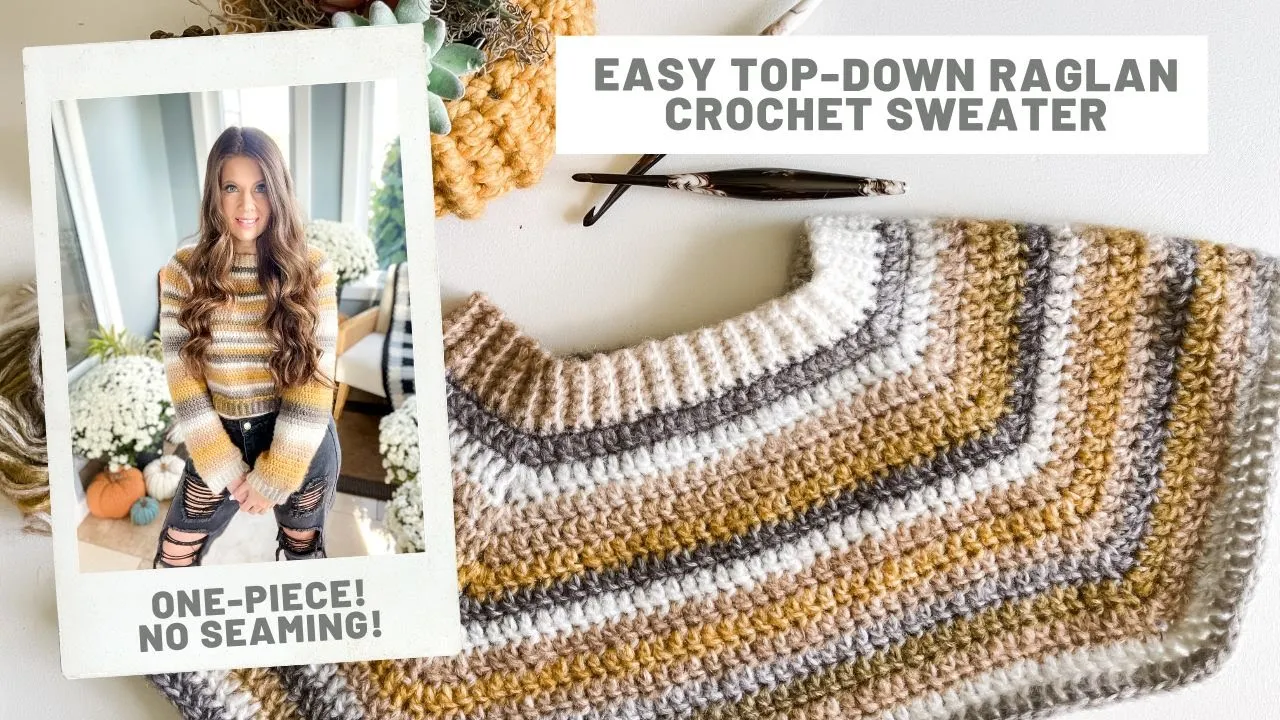
Why This Sweater Is a Classic
Raglan sweaters are a classic because the diagonal seams from neck to underarm create a flattering shape that suits most bodies. This style has stayed popular for decades in both knit and crochet garments.
Is This Sweater Hard to Crochet?
This sweater is not hard to crochet. Beginners tackle top-down raglans successfully all the time because you work in continuous rounds with basic increases, no seaming, and constant try-ons for perfect fit.
Mistakes happen to everyone—I've frogged plenty in my day—and they always fix easily here. Don't worry if your tension wobbles a bit; it adds character, and you'll wear it proudly anyway.
Materials Needed for Your Easy Cozy Raglan Crochet Sweater
For this Easy Cozy Raglan Crochet Sweater, you'll need about 4-5 skeins of worsted weight yarn like Lion Brand Mandala Ombre, totaling around 1376 yards for a medium size.
You'll also need a US H/8 (5mm) crochet hook for the ribbing and a US J/10 (6mm) hook for the body, plus a tapestry needle, stitch markers, scissors, and a measuring tape.
I've chosen these materials because they're affordable and widely available at craft stores like Michaels or online at yarn.com as of 2025.
Don't fret if your yarn stash has something similar—stash-busting is my favorite part, and slight variations in gauge can be adjusted as we go.
Crochet Abbreviations in US Terms
Crochet abbreviations in US terms for this pattern include beg for beginning, blo for back loop only, ch for chain, dc for double crochet, hdc for half double crochet, pm for place marker, rep for repeat, rev sl st for reverse slip stitch, RS for right side, sc for single crochet, sk for skip, sl st for slip stitch, st(s) for stitch(es), V-st for (ch 3, dc, ch 3, dc) in specified st or sp, WS for wrong side, and YU for yarn under.
I've listed them all here so you can refer back easily—print this out if it helps.
Gauge and Sizing Information
Gauge for the body is 13 stitches and 8 rounds equal 4 inches in double crochet using the 6mm hook.
For the ribbing, gauge is 8.5 stitches and 8.5 rows equal 2 inches in single crochet back loop only pattern with the 5mm hook.
This pattern fits adult medium with a bust circumference of about 40 inches, but you can try it on as you crochet to tweak for your body.
Swatching is key, but if your gauge is off a bit, no biggie—I've made looser versions that turned out slouchy and cute.
How to Crochet the Collar
To crochet the collar, start with the smaller 5mm hook and chain 7.
Row 1 (WS): Make 1 sc in the 2nd chain from the hook, then 1 sc in each chain across, turn—6 sts.
Row 2 (RS): Chain 1, make 1 sc in the back loop only of each stitch across, turn—6 sts.
Rows 3-84: Repeat Row 2.
After the final row, chain 1, fold the collar with right sides facing, and slip stitch the first and last rows together through the back loop only.
Flip the collar so the seam is on the inside.
This ribbed collar is stretchy and comfy— if it feels tight, you can add a few more rows, easy peasy.
Building the Yoke
To build the yoke, start with the setup round: Chain 1, work single crochet stitches evenly around the collar edge, placing 1 stitch per row, then slip stitch in the first sc to join—84 sts.
Change to the larger 6mm hook.
Round 1: (Chain 3, 1 dc in first st) to make the beginning V-st, then 1 dc in each of next 17 sts for the right sleeve, V-st in next st, 1 dc in each of next 23 sts for the front, V-st in next st, 1 dc in each of next 17 sts for the left sleeve, V-st in next st, 1 dc in each of next 23 sts for the back, slip stitch in V-st to join—88 sts not including chains.
Round 2: Make beginning V-st in chain space, then 1 dc in each st across to next V-st, V-st in V-st; repeat from * around omitting last V-st, slip stitch in V-st to join—96 sts.
Rounds 3-18: Repeat Round 2, with each section increasing by 2 sts each round, totaling an increase of 8 sts per round, ending with 224 sts.
You're increasing at those four raglan points—it's like magic how it shapes up, and if you miscount, just frog back a round; I've done it a hundred times.
Separating the Body and Sleeves
To separate the body and sleeves, chain 4 for underarm chains, skip over the sleeve section to the next V-st, slip stitch in V-st to join and fasten off.
Skip over the front section, put a slip knot on the hook, join yarn in the next V-st with slip stitch, chain 4 for underarm chains, skip over the next sleeve section, join yarn in the next V-st with slip stitch and fasten off.
This creates the armholes—super straightforward, and no sewing required, which is why I adore raglans.
Crocheting the Body
To crochet the body, work in continuous rounds; mark the first stitch of each round with a marker and move it up each round.
Round 1: Put a slip knot on the hook, at the join, join yarn in the 3rd chain with slip stitch, make 1 dc in the same chain, then 1 dc in each chain and stitch around—126 sts.
Round 2: Make 1 dc in the first st (place marker in st), then 1 dc in each st around—126 sts.
Rounds 3-19: Repeat Round 2.
In the last round, work 1 hdc in the last st.
Round 20: Work 1 sc in the first st, then 1 sc in each st around, slip stitch in the first sc to join.
Feel free to add or subtract rounds here for length—try it on, that's the beauty of top-down.
Adding the Bottom Band
To add the bottom band, join it as you go to the body edge using the smaller 5mm hook.
Row 1: Chain 9, make 1 sc in the 2nd chain from the hook and in each chain across, skip the first st at the body edge, slip stitch in the next 2 sts on the body edge, turn—8 sts.
Row 2: Skip the slip stitches, make 1 sc in the back loop only of each st across, turn—8 sts.
Row 3: Chain 1, make 1 sc in the back loop only of each st across, slip stitch in the next 2 sts on the body edge, turn—8 sts.
Rows 4-126: Repeat Rows 2 and 3, ending on Row 2.
In the last row, chain 1, with right sides facing, slip stitch the band together, fasten off and weave in ends.
This ribbing adds a snug fit— if you want it wider, chain more at the start.
Working the Sleeves
To work the sleeves, repeat for both, leaving a long tail at the start.
Round 1: Skip over the first 2 chains of the underarm, join yarn in the 3rd chain, chain 2, make 1 dc in the same chain and next chain, then 1 dc in each st around, work 1 dc in the last 2 chains, reverse slip stitch in the first dc to join—57 sts.
Round 2: Chain 2, dc2tog across the first 2 sts, then 1 dc in each st around, reverse slip stitch in the first dc to join—56 sts.
Round 3: Chain 2, make 1 dc in each st around, reverse slip stitch in the first dc to join—56 sts.
Rounds 4-30: Repeat Rounds 2 and 3, ending with 42 sts.
Round 31: With the smaller hook, make 1 sc in the first st, sc2tog across the next 2 sts; repeat from around, slip stitch in the first sc to join—28 sts.
Sleeves taper gently—adjust decreases if your arms are longer or shorter; no one's symmetrical anyway.
Finishing with the Cuffs
To finish with the cuffs, join them as you go to the sleeve edge using the smaller 5mm hook.
Row 1: Chain 9, make 1 sc in the 2nd chain from the hook and in each chain across, skip the first st at the sleeve edge, slip stitch in the next 2 sts on the sleeve edge, turn—8 sts.
Row 2: Skip the slip stitches, make 1 sc in the back loop only of each st across, turn—8 sts.
Row 3: Chain 1, make 1 sc in the back loop only of each st across, slip stitch in the next 2 sts on the sleeve edge, turn—8 sts.
Rows 4-28: Repeat Rows 2 and 3, ending on Row 2.
In the last row, chain 1, with right sides facing, slip stitch the cuff together, fasten off and weave in ends.
Weave in any remaining ends with your tapestry needle, and give it a gentle block if needed.
There you have it—your very own sweater! Mistakes? They build character. Wear it with pride, friend.
Pattern Notes for Beginners
Pattern notes for beginners include key tips: this sweater is worked top-down and seamless, so you try it on frequently to check fit—no seaming needed at the end.
The pattern uses a multiple of 4 stitches in some sections for even ribbing, but the main body works with any count after separation.
Place stitch markers at the four raglan points and move them up each round—they save you from recounting every time.
Work loosely on the yoke increases for better drape, and always count your stitches after the first few rounds to catch mistakes early.
If you're new to garments, remember gauge matters, but slight differences just make it more custom to you—I've worn "off-gauge" sweaters for years and loved them.
Key Crochet Abbreviations Used
Ch stands for chain: yarn over and pull through loop on hook.
Dc stands for double crochet: yarn over, insert hook, yarn over pull through, yarn over pull through two loops, yarn over pull through last two.
Dc3tog stands for double crochet 3 together: a decrease stitch where you yarn over, insert hook into next stitch, pull up loop, yarn over pull through two, repeat twice more, then yarn over and pull through all four loops on hook.
Other common ones: sc for single crochet, hdc for half double crochet, sl st for slip stitch, st(s) for stitch(es), rep for repeat, blo for back loop only.
You've done it—you crocheted a whole sweater from scratch, and it fits you perfectly because you made it.
Block it gently if you want, weave in those last ends, and throw it on for that first wear.
I can't wait to see your version—please share photos with me on Instagram or wherever you post your makes; tag me so I can cheer you on and repost.
You've got this hooking thing down now, friend. What's next in your stash?

The Author
I'm Joanna T. Grey. I've been designing crochet patterns for over a decade, and I focus on modern, wearable pieces with clear, tested instructions. Every pattern here is written so you actually understand the why behind each step—not just what to do. Even if you're new or experienced, you'll find practical guidance and designs that work.


